

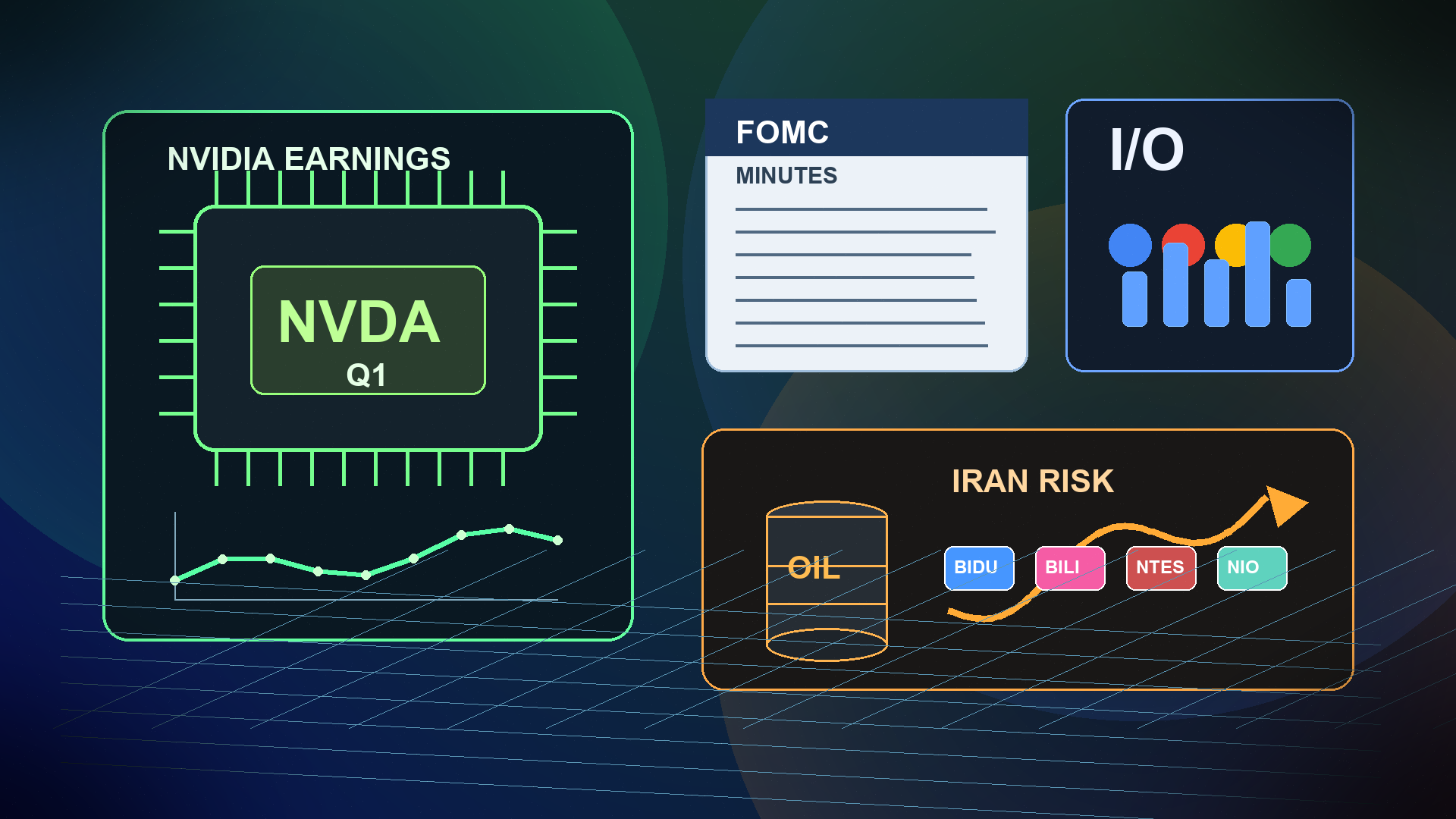
NextFin WeekAhead - This week asks whether AI leadership is still strong enough to absorb a tighter rates tape and a renewed Middle East risk premium. Nvidia reports Wednesday, Google I/O runs Tuesday-Wednesday, the FOMC minutes land Wednesday afternoon, and China ADR earnings from Baidu, Bilibili, NetEase, and NIO add a second read on consumer, AI, gaming, and EV demand.
Data as of 2026-05-15 16:00 ET. All prices reference Friday's regular-session close unless noted. Sources cited inline.
Markets & Macro
Executive Summary
- The AI week is the equity market's real macro event - Nvidia reports Q1 FY27 after Wednesday's close with Street revenue near $78.8B and adjusted EPS near $1.76-$1.77; the bigger test is whether Q2 guidance clears the $86B area (TECHi, May 12; Motley Fool, May 14).
- Fed minutes matter because rates already repriced higher - 10Y yield closed at 4.59%, +21 bps on the week, while 2Y rose to 4.09%, +19 bps (FMP treasury-rates, May 15).
- Google I/O turns AI from capex into product proof - Google confirmed I/O for May 19-20, with expected updates across Gemini, Android, and companywide AI products (Google, Mar 6).
- China ADRs make this more than a Nvidia week - Baidu reports Monday, Bilibili Tuesday, and NetEase plus NIO Thursday; the read-through spans AI search, gaming, online entertainment, and EV demand (company releases, May 2026).
- Oil is the geopolitical transmission channel - WTI closed at $105.42, +10.48% w/w, and Brent at $109.26, +7.87% w/w, as Trump signaled a harder line on Iran and markets repriced supply risk (FMP, May 15 close; Reuters via Investing.com, May 12).
Macro Pulse - The Backdrop
The market enters the week with three stories competing for the same discount rate. First, AI earnings and product cycles are still the main reason large-cap growth can defend premium multiples. Nvidia's setup is unusually clean on the headline number but less forgiving on guidance: the Street already expects Q1 FY27 revenue near $78.5B-$78.8B and Data Center revenue near $72.8B, with Blackwell and Rubin assumptions embedded in 2027 estimates (S&P Global Market Intelligence, May 14). A routine beat may not be enough if guidance implies the AI capex curve is flattening.
Second, the Fed minutes due May 20 at 2:00 p.m. ET cover the April 28-29 meeting, according to the Federal Reserve's official calendar (Federal Reserve, Apr 29). The minutes matter because the bond market has already done some tightening for the Fed: 30Y yield ended at 5.12%, +17 bps w/w, while the real 10Y yield was 2.00% as of May 14 (FMP treasury-rates, May 15; FRED DFII10, May 14). If the minutes emphasize energy inflation, services persistence, or committee division, the 10Y could probe 4.65%-4.75%. A softer balance-of-risks discussion would help duration and high-duration tech.
Third, the Middle East risk premium is no longer theoretical for energy. Reuters reported that Trump said preventing Iran from acquiring a nuclear weapon takes priority over Americans' economic pain, a framing that tells markets he is willing to tolerate higher energy prices if negotiations fail (Reuters via Investing.com, May 12). That does not make escalation the base case, but it keeps oil volatility in the macro channel.
Cross-Asset Performance - Last Week
| Asset | Close | Week % | YTD % |
|---|---|---|---|
| S&P 500 | 7,408.49 | +0.13% | +8.02% |
| Nasdaq 100 | 29,125.20 | -0.38% | +15.55% |
| Dow Jones | 49,526.18 | -0.17% | +2.36% |
| Russell 2000 | 2,793.30 | -2.37% | +11.37% |
| MSCI EAFE | 101.72 | -2.15% | +4.82% |
| US 10Y Yield | 4.59% | +21 bps | [N/A] |
| US 2Y Yield | 4.09% | +19 bps | [N/A] |
| DXY | 99.205 | +1.45% | +1.00% |
| WTI Crude | $105.42 | +10.48% | +82.80% |
| Brent Crude | $109.26 | +7.87% | +78.76% |
| Gold | $4,561.90 | -3.57% | +3.99% |
| Bitcoin | $79,058.51 | -1.41% | -10.91% |
| Ethereum | $2,223.00 | -3.65% | -25.91% |
| VIX | 18.43 | +7.21% | - |
| MOVE | 79.87 | +18.77% | - |
Sources: FMP, FRED, CoinGecko. May 15 close unless noted.
Key Levels & Triggers - This Week
| Asset | Bullish above | Bearish below | Key event this week |
|---|---|---|---|
| S&P 500 | 7,475 | 7,300 | NVDA Wed AMC, Google I/O Tue-Wed |
| 10Y Yield | - | 4.45% bullish for duration | FOMC minutes Wed 2:00 ET |
| DXY | - | 98.50 | Fed minutes and PMI Thu |
| WTI | $110 | $100 | Iran headlines, EIA inventories Wed |
| Gold | $4,650 | $4,500 | Real yield / dollar reaction |
| BTC | $82k | $76k | ETF flows and risk appetite |
| VIX | - | 22+ stress close | NVDA and Fed minutes reaction |
Levels are approximate support/resistance zones derived from recent price action, not precise technical targets.
US Equities
Equity leadership narrowed last week but did not break. The S&P 500 held a small gain at 7,408.49, while the Nasdaq 100 slipped 0.38% and the Russell 2000 fell 2.37%, consistent with higher real yields pressuring duration-sensitive and lower-quality risk (FMP, May 15 close). Sector dispersion was more revealing than the index close: Energy rose 6.71% as oil repriced geopolitical risk, while Consumer Discretionary fell 3.05%, Real Estate lost 2.66%, and Materials fell 2.50% (FMP, May 15 close).
This week is a test of whether AI can re-broaden growth leadership. Nvidia is the main event because the market already believes the Q1 number will be strong; the reaction depends on whether management can support Q2 revenue consensus near $86B and keep the Blackwell/Rubin demand story intact (TECHi, May 12; S&P Global Market Intelligence, May 14). Google I/O matters differently. It is not an earnings report, but it is the week's best public read on whether AI spend is becoming product velocity across Search, Gemini, Android, Cloud, and developer tools. If Google shows credible monetization paths, the event supports the hyperscaler capex cycle. If the keynote is product-rich but monetization-light, the market may keep asking whether AI capex is outrunning near-term returns.
AMD adds a secondary read-through. Its AI DevDay recap emphasized ROCm, Day 0 model support, Triton performance CI, Hugging Face integration, vLLM/SGLang contributions, and OpenAI-compatible AI Endpoint APIs on MI350X infrastructure (AMD, May 6). For AMD, the market is not asking whether it can describe an open AI stack. It is asking whether developers and cloud partners can make that stack feel investable against Nvidia's software gravity.
China ADRs add a separate but important earnings channel. Baidu reports Monday before the open, where investors will look for whether AI search and cloud can offset ad-cycle softness (Baidu IR, May 2026). Bilibili reports Tuesday before the open, with the key debate around gaming recovery, ad monetization, and whether cost discipline can keep margins moving in the right direction (Bilibili IR, May 2026). NetEase and NIO both report Thursday before the open, making that session a useful cross-check on China's digital entertainment cycle and EV demand after several quarters of price competition (NetEase IR and NIO IR, May 2026).
Earnings spotlight - this week:
| Date | Ticker | Time | Why it matters |
|---|---|---|---|
| Mon May 18 | BIDU | BMO | China AI-search and cloud read; watch whether AI product spend is translating into revenue. |
| Tue May 19 | HD | BMO | Consumer and housing demand check; consensus EPS $3.42, revenue $41.60B (FMP). |
| Tue May 19 | BILI | BMO | China online entertainment read; watch game pipeline, ad growth, and margin discipline. |
| Wed May 20 | NVDA | AMC | AI capex bellwether; Q2 guide above $86B supports the AI complex, below that risks de-rating. |
| Wed May 20 | LOW | BMO | Housing repair demand and rate sensitivity; consensus EPS $2.96, revenue $22.98B (FMP). |
| Wed May 20 | TGT | BMO | Discretionary stress check after XLY underperformance; consensus EPS $1.45, revenue $24.66B (FMP). |
| Thu May 21 | WMT | BMO | Staples and consumer wallet share; consensus EPS $0.65, revenue $174.72B (FMP). |
| Thu May 21 | NTES | BMO | China gaming and content demand; a strong guide would help China internet sentiment. |
| Thu May 21 | NIO | BMO | China EV demand and margin check; pricing discipline matters more than deliveries alone. |
Macro & Rates
Rates moved in the wrong direction for equity duration last week. The 2Y finished at 4.09%, the 10Y at 4.59%, and the 30Y at 5.12%, with the curve steepening modestly as the 2s10s spread reached +50 bps (FMP treasury-rates, May 15; FRED T10Y2Y, May 15). DXY rose 1.45% to 99.205, and USD/JPY at 158.718 keeps intervention risk in the background (FMP, May 15 close).
The Fed minutes are the week's macro hinge. The official calendar lists May 20 minutes for the April 28-29 meeting, and Kiplinger notes investors will read them for evidence of committee division after the April hold (Federal Reserve, Apr 29; Kiplinger, May 15). We are not using stale FedWatch probabilities in this draft because the most current figures could not be confirmed from a primary or reliable public source before publication. Instead, the tradeable question is simpler: a minutes tone that keeps hikes or prolonged restrictive policy alive would push the 10Y toward 4.70% and pressure NDX, while a softer tone plus PMI slippage Thursday would pull yields toward 4.45% and help growth multiples.
Crypto
Crypto enters the week as a risk asset with weaker flow support. Bitcoin closed at $79,058.51, -1.41% w/w, while ETH fell 3.65% to $2,223.00; BTC dominance was 58.31%, high enough to suggest investors are not yet rotating into higher-beta crypto (FMP, May 15 close; CoinGecko, May 16). U.S. spot bitcoin ETF flow trackers showed a trailing five-day net outflow of about $0.85B as of May 15, which removes a near-term structural bid (BTCOAK, May 15).
BTC needs a close above $82k to reassert upside momentum. Below $76k, the message would shift from consolidation to risk-off confirmation, especially if Fed minutes lift real yields or Nvidia disappoints. ETH remains the weaker expression until ETH/BTC stabilizes; for now, BTC dominance rising while ETF flows soften argues for selectivity.
Commodities - Oil & Gold
Oil. Oil is the clearest geopolitical hedge in the tape. WTI closed at $105.42, +10.48% w/w, and Brent at $109.26, +7.87% w/w, leaving the Brent-WTI spread near $3.84 (FMP, May 15 close). The bullish case is not simply supply disruption; it is a policy premium tied to Trump's harder Iran stance and the market's fear that negotiations can fail without much warning. EIA inventories Wednesday are the mechanical catalyst. A draw would support a WTI test of $110, while a build and calmer Iran headlines would argue for a move back toward $100.
Gold. Gold fell 3.57% to $4,561.90 even as geopolitical risk rose, which tells us the dollar and real-yield channel dominated the safe-haven channel (FMP, May 15 close). The real 10Y yield was 2.00% as of May 14, a level that usually requires either strong central-bank demand or acute risk aversion to keep gold firm (FRED DFII10, May 14). A move back above $4,650 would signal that geopolitical hedging is regaining control. Below $4,500, gold is vulnerable to further long liquidation.
Bonds & Credit
Credit is not confirming an equity stress event. HY OAS tightened to 276 bps and IG OAS to 76 bps as of May 14, both down 3 bps from the prior week (FRED BAMLH0A0HYM2 and BAMLC0A0CM, May 14). That is constructive, but it is also late-cycle tight: spreads leave little cushion if oil squeezes margins or if Nvidia triggers a growth-stock air pocket. The Treasury curve is more fragile than credit; a 30Y yield above 5.20% would pull attention back to fiscal supply and duration risk.
Volatility & Sentiment
Vol is rising, but not yet pricing a disorderly week. VIX closed at 18.43, +7.21% w/w, and MOVE closed at 79.87, +18.77% w/w, which says rates volatility is doing more work than equity volatility (FMP, May 15 close). AAII sentiment is balanced: bulls rose to 39.3%, bears rose to 36.6%, and the bull-bear spread narrowed to +2.7 points, below its historical average (AAII, May 16).
That leaves hedging asymmetry. Into Nvidia, Google I/O, Fed minutes, and oil headline risk, a VIX below 19 is not expensive if the market has to process a guidance miss and a hawkish minutes tone on the same day. We would treat a VIX close above 22 as the stress threshold. Below that, dips are more likely to be rotation than regime break.
Economic Calendar - This Week
| Date / Time ET | Event | Consensus | Prior | NextFin Read |
|---|---|---|---|---|
| Mon 10:00 | NAHB Housing Market Index | 34 | 34 | Tier 3; housing sentiment is rate-sensitive but unlikely to lead the week. |
| Tue 10:00 | Pending Home Sales MoM | 1.6% | 1.5% | Tier 3; matters if rates-sensitive equities are already weak. |
| Wed 10:30 | EIA Crude Oil Stocks | [N/A] | -4.306M | Tier 2 because oil is the geopolitical transmission channel. |
| Wed 14:00 | FOMC Minutes | [N/A] | [N/A] | Tier 1; watch inflation language, dissent, and balance-of-risks framing. |
| Thu 08:30 | Initial Jobless Claims | 210K | 211K | Tier 2; a claims rise would help duration. |
| Thu 08:30 | Housing Starts | 1.420M | 1.502M | Tier 2; rate sensitivity matters with 10Y near 4.6%. |
| Thu 09:45 | S&P Global Manufacturing PMI | 53.8 | 54.5 | Tier 2; below 52 would challenge growth confidence. |
| Thu 09:45 | S&P Global Services PMI | 51.3 | 51.0 | Tier 2; below 50 would support duration but hurt cyclicals. |
Source: FMP economic calendar, supplemented by Federal Reserve release schedule.
Scenario Framework
Base case (55%): Nvidia beats and guides close to or modestly above the $86B Q2 consensus area; Google I/O reinforces the AI product story without changing capex anxiety; FOMC minutes sound cautious but not overtly hawkish; China ADR earnings are mixed but not destabilizing. SPX holds 7,300-7,475, VIX stays below 22, and 10Y remains below 4.65%.
Bull case (25%): Nvidia guides above $90B, Google delivers credible Gemini/Android/Search monetization updates, the minutes avoid fresh inflation alarm, and China internet earnings show better margin discipline. SPX breaks 7,475, NDX regains leadership, VIX moves toward 16, and BTC reclaims $82k.
Bear case (20%): Nvidia guides below $86B, minutes emphasize inflation risk and committee division, China ADRs point to weaker consumer demand, and Iran headlines keep WTI above $110. SPX loses 7,300, 10Y tests 4.75%, VIX closes above 22, and BTC retests $76k.
What would change our view mid-week: A Nvidia Q2 guide below $86B would move us from base to bear because it would challenge the AI capex extrapolation at the same time rates are already restrictive.
Investment Playbook - Positioning Into the Week
- Equities: Neutral-to-overweight US large-cap AI. Entry: add only on SPX 7,300-7,350 or after NVDA guide confirmation. Target / Stop: 7,475 target, stop below 7,250. Invalidation: NVDA guide below $86B plus VIX >22.
- Rates / Duration: Neutral duration. Entry: add 5-7Y exposure if 10Y spikes above 4.70% without a new inflation shock. Target / Stop: 4.45% target, 4.80% stop. Invalidation: minutes show renewed openness to hikes.
- USD: Neutral DXY. Entry: fade strength above 100 only if minutes are balanced. Target / Stop: 98.50 target, 100.75 stop. Invalidation: oil shock plus hawkish minutes.
- Crypto: Long BTC only on confirmation. Entry: add above $82k or near $76k support with tight risk. Target / Stop: $86k target, $74k stop. Invalidation: renewed ETF outflows and real yields above 2.05%.
- Commodities: Long oil optionality, neutral gold. Entry: WTI pullbacks toward $100 if Iran risk persists. Target / Stop: $110 target, $97 stop. Invalidation: de-escalation headlines and inventory build.
- Volatility: Own limited index downside into Wednesday. Entry: VIX below 19. Target / Stop: monetize above 22, close if NVDA guides above $90B and minutes are balanced.
This is a research view, not personalized investment advice. NextFin readers should size to their own risk tolerance and consult a licensed advisor for individual decisions.
Key Market Signals
A weekly read of the signals we think matter most for the week ahead. Use this dashboard to triangulate where positioning, valuation, liquidity, and risk appetite are pulling the tape.
Signal Dashboard
| # | Signal | Direction | Reading | Implication |
|---|---|---|---|---|
| 1 | Net Liquidity | Bullish | Fed BS $6.729T, TGA $0.839T, RRP $0.001T; net approx. $5.889T, +$58B w/w | Liquidity is a modest tailwind. |
| 2 | HY OAS | Bullish | 276 bps, -3 bps w/w | Credit is not confirming equity stress. |
| 3 | 10Y Real Yield | Bearish | 2.00%, +4 bps w/w | Valuation headwind for growth. |
| 4 | 2s10s Slope | Neutral | +50 bps, +2 bps w/w | Curve is stable but no longer easing financial conditions. |
| 5 | VIX | Neutral | 18.43, +7.21% w/w | Event risk is rising but not stressed. |
| 6 | MOVE | Bearish | 79.87, +18.77% w/w | Rates vol is the main macro pressure point. |
| 7 | AAII Bull-Bear Spread | Neutral | +2.7 pts | Sentiment is balanced, not euphoric. |
| 8 | BTC ETF 5D Net Flow | Bearish | -$0.85B | Crypto lacks a near-term flow bid. |
| 9 | BTC Dominance | Neutral | 58.31% | Crypto risk appetite remains defensive. |
| 10 | Oil Risk Premium | Bearish | WTI +10.48% w/w | Energy inflation risk is back in the macro channel. |
Legend: Bullish = supportive of risk assets / base case; Bearish = against; Neutral = mixed.
Featured Signals - Deep Dive
Signal 1: Net liquidity is quietly supportive
Net liquidity improved into the week. Fed balance sheet assets rose to $6.729T, TGA fell to $0.839T, and RRP fell to $0.001T, leaving our simple Fed BS minus TGA minus RRP proxy near $5.889T, up roughly $58B w/w (FRED WALCL, WTREGEN, RRPONTSYD, May 13-15). That is not a reason to ignore valuation, but it helps explain why credit spreads stayed tight even as yields rose. Liquidity support is most useful when the week's catalysts do not break the earnings story. If Nvidia guides cleanly, this liquidity backdrop can help dips find buyers. Invalidation: TGA rebuilds sharply or RRP rises back above $50B. Trade expression: keep equity hedges limited rather than moving net short unless SPX loses 7,300.
Signal 2: Real yields are the constraint on AI multiples
The real 10Y yield reached 2.00% as of May 14, up 4 bps w/w (FRED DFII10). That level does not prevent AI stocks from rising, but it raises the hurdle rate for every long-duration narrative. The equity market can absorb a high real yield if earnings revisions move higher faster than discount rates. That is why Nvidia's guide matters more than the Q1 beat. A strong guide can turn a 2% real yield into a manageable valuation input. A soft guide would make the same real yield feel restrictive. Invalidation: real 10Y falls back below 1.90%. Trade expression: prefer confirmed AI earnings over speculative AI beta until yields ease.
Signal 3: Oil is the inflation tail risk
WTI's 10.48% weekly gain is the signal that geopolitics has re-entered the inflation discussion (FMP, May 15 close). The market is not pricing a full supply shock, but Trump's Iran stance keeps the risk premium sticky enough to matter for Fed minutes, breakevens, airlines, transports, and consumer sentiment. A WTI close above $110 would force a broader macro conversation about energy pass-through. A move back below $100 would tell us the market is fading the escalation premium. Invalidation: verified de-escalation and a bearish EIA build. Trade expression: use oil exposure as a hedge against the bear case rather than a standalone high-conviction long.
Signal 4: Crypto flows are no longer helping
BTC price held near $79k, but ETF flows weakened. BTCOAK's tracker showed a trailing five-day net outflow of $0.85B as of May 15, while BTC dominance stayed high at 58.31% (BTCOAK, May 15; CoinGecko, May 16). That mix argues against broad crypto risk-on. BTC can still rally if Nvidia and rates generate a risk-on week, but the flow impulse is not doing the heavy lifting. Invalidation: two consecutive sessions of net ETF inflows and a BTC close above $82k. Trade expression: BTC over ETH until dominance rolls over.
Closing - What to Watch
- Tue-Wed: Google I/O - Gemini, Android, Cloud, and developer tooling updates need to show AI monetization, not just model velocity.
- Mon-Thu: China ADR earnings - Baidu, Bilibili, NetEase, and NIO test whether AI, gaming, and EV demand can stabilize China ADR sentiment.
- Tue BMO: Home Depot - EPS $3.42 and revenue $41.60B consensus; weak guidance would confirm higher-rate pressure on the consumer.
- Wed 10:30 ET: EIA inventories - a crude draw supports WTI $110; a build plus calmer Iran headlines points back toward $100.
- Wed 14:00 ET: FOMC minutes - inflation language and dissent framing are the rates trigger; 10Y above 4.65% pressures NDX.
- Wed AMC: Nvidia Q1 FY27 - Q1 consensus is near $78.8B revenue, but the real trigger is Q2 guidance versus the $86B area.
- Thu 09:45 ET: S&P Global PMI - manufacturing below 52 or services below 50 would shift the week toward growth concern.
- Thu BMO: Walmart - consensus revenue $174.72B; margin commentary is the cleanest consumer read after oil's jump.
Explore more exclusive insights at nextfin.ai.


